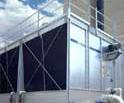

Ozone in cooling towers
Ozone in cooling towers
Ozone is a powerful disinfectant and an interesting alternative to chemical biocides for the water treatment of cooling towers. The use of ozone in cooling towers has a number of major advantages. However, ozone also has limitations that must be taken into account during the design phase to prevent problems:
The benefits of ozone are:
- Safe and easy to use
- Low maintenance costs
- Ozone is produced on-site and requires no storage of hazardous chemicals
- Ozone requires no additional disinfectants
- No cocktail of disinfectants needed. Microorganisms cannot become resistant to ozone after prolonged use of ozone
- Very effective as a disinfectant. A residual ozone concentration of 0.1 to 0.2 ppm is in most cases very effective in keeping the cooling tower and the cooling circuit clean.
- Very effective in removing biofilms
- Higher efficiency of heat exchangers due to reduced biofilm formation
- Thanks to the good biofilm removal capacity very effective against Legionella
- No chlorinated compounds. Very low corrosion rates in the system.
- No persistent chemicals or disinfectants in the drain fluid. Ozone breaks down into oxygen.
- In some cases, ozone can replace disinfectants, dispersants, and inhibitors.
- In many cases, a higher concentration factor is possible.
- Lower operating costs and, in many cases, lower total costs.
- Ozone is effective in a wide pH range.
- Also effective for the growth of mussels.
When designing a good ozone-disinfected cooling tower, the following points must be taken into account:
- Batch water with high hardness and/or high COD values is less suitable for ozone cooling towers.
- Retention time in the system. The half-life of ozone is normally less than 10 minutes in cooling systems. To ensure an adequate residual ozone concentration, it is necessary to start with an adequate initial concentration.
- Dead zones. Because ozone is converted into oxygen, zones with low circulation must be avoided.
- Temperature. The solubility of ozone and the half-life of ozone decrease at higher temperatures. This limits the temperature of the cooling water in which ozone can be used. In most cases, this limit is around 45°C.
- Material. The materials used in the cooling tower must be ozone-resistant.
Please contact us if you have any questions.
Ozone generators